
Solutions
Climate Risk Analytics:
Assess, Mitigate, and Thrive

Understanding the need for climate change scenario analysis
Climate change is a pressing global challenge impacting individuals and businesses worldwide.
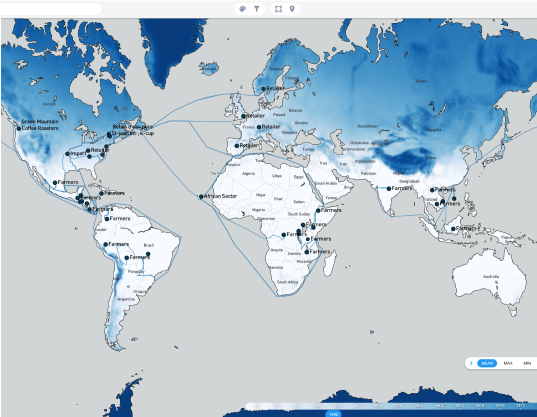
At Correntics, we understand the urgency of addressing physical climate risks through advanced climate risk assessment methods. Our expertise lies in visualizing, analyzing, assessing, and modeling climate-change risks for production sites, supply chains, and assets using advanced climate risk analytics and climate risk modeling approaches. We empower organizations with climate risk intelligence to enhance resilience and competitiveness in an ever-changing climate.
In today's interconnected world, even remote climate events can disrupt global supply chains, affecting businesses globally, making continuous climate-risk analysis essential for strategic descision-making
Understanding the need for climate risk analytics

Global impacts of climate extremes
Correntics' climate change risk analysis solutions help to:
- Enhance resilience
- Identify vulnerability
- Maintain competitiveness in the middle of a rapidly changing climate system
The Correntics climate risk platform delivers scalable insights that support both immediate and long-term climate risk assessment needs. Key benefits include:
- Understanding of physical climate risk
- Climate risk analysis across value chains
- Integration of climate risk modeling into decision-making
- Continuous climate risk analysis software support for operations
Global impacts of climate extremes

Scenario analysis for an uncertain future
- Scenario analysis helps define robust strategies in response to increasing climate-risk analysis requirements and opportunities.
- Correntics' expertise in climate risk management, coupled with a data-driven approach customized to your specific needs, equips you to navigate uncertainties and make informed decisions that drive long term success.
Scenario analysis for an uncertain future
Key Features
Our comprehensive climate change data analysis supports your organization's climate resilience:
Climate risk
scenario analysis
Assess and anticipate potential climate change impacts on your operations and supply chains with our climate risk analysis software.
Supply-chain mapping
and risk analytics
Identify vulnerabilities and risks within your supply chain to enhance operational resilience using our climate risk intelligence services.
High-resolution
climate data
Correntics as a climate risk data provider, provides accurate and up-to-date climate data to identify and mitigate critical climate risks.
Probabilistic risk
modeling
Use sophisticated climate risk modeling to address organizational risk exposure and uncertainty effectively.
Climate risk evaluation
and adaptive strategies
Evaluate immediate and future climate-related risks and implement effective mitigation strategies through our climate risk platform.
Navigate the complex
climate risk landscape
Master the emerging climate risks with our expertise, tools, and insights using our climate risk intelligence platform.
FAQ
What is climate risk assessment?
Climate risk assessment is a structured evaluation of how physical climate risk such as floods, heatwaves, storms, or droughts may impact assets, operations, and supply chains.
It combines climate risk modeling, geospatial data, and scenario analysis to identify vulnerabilities and quantify potential financial and operational impacts.
At Correntics, our climate risk assessment approach helps organizations understand both current and future risks across global value chains.
What is physical climate risk?
Physical climate risk refers to direct impacts from climate-related events such as floods, heatwaves, storms, or droughts that can disrupt infrastructure, supply chains, and operations.
What makes the Correntics climate risk analysis software different?
Our climate risk analysis software combines high-resolution hazard modeling with scalable analytics. It enables users to:
- Run asset-level climate risk assessment
- Perform portfolio-wide climate risk analytics
- Generate regulatory-ready reports
- Integrate outputs into internal systems via APIs
Is Correntics a climate risk data provider?
Correntics is a climate risk data provider and climate risk analytics company.
We integrate high-quality data for accurate and consistent climate risk data for decision-making.
Who uses the Correntics climate risk analysis tools?
Our solutions are used by:
- Manufacturing and industrial companies
- Consulting and advisory firms
- Energy and utility providers
- Financial institutions and asset managers
- Insurance companies
Correntics: Your Climate Risk Solutions Provider
Correntics: Your Climate Risk Solutions Provider
Discover how we empower you to tackle climate challenges, safeguard assets, and thrive sustainably.