What Is ESG Risk Assessment? A Step-by-Step Guide for Businesses
Sustainability is no longer a communications topic. It is a risk topic.
Companies today are not only exposed to market volatility or operational disruption. Heatwaves, floods, droughts, supplier shutdowns, and energy transitions expose them to significant risk. Many organizations only realize this after a factory stops operating, a shipment never arrives, or insurance costs suddenly spike.
That’s why businesses are now asking a very practical question: What is ESG risk assessment?
An ESG risk assessment is a structured process that identifies, evaluates, and manages environmental, social, and governance risks that could disrupt operations, damage reputation, or affect financial performance. It turns sustainability from a reporting obligation into a business protection system.
At Correntics, the focus sits primarily on the Environmental side of ESG. Because, in reality, climate and environmental exposure is often the first ESG risk a company faces—and the most financially material.
Understanding ESG
What are the 3 pillars of ESG?
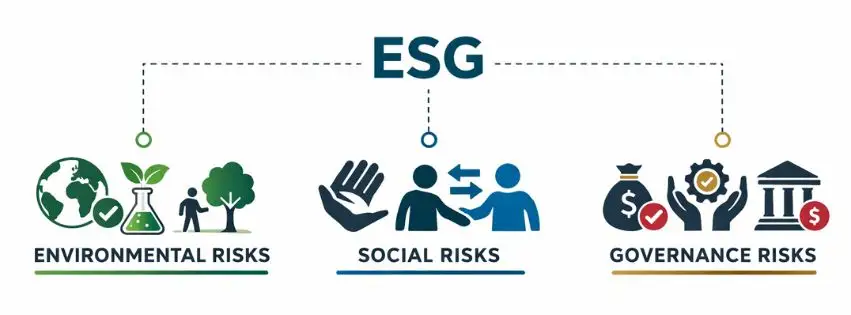
ESG consists of three dimensions of risk and responsibility:
- Environmental: climate change and physical hazards, emissions, water usage, waste, pollution, loss of biodiversity
- Social: employee safety, labor standards, community impact, and human rights
- Governance: ethics, compliance, internal controls, transparency, and leadership oversight
While social and governance issues matter, environmental risks are increasingly the trigger for challenges that organizations might face. A flood can shut down production. A drought can halt the supply of raw materials. A heatwave can reduce workforce productivity.
What are the main categories of climate-related risk?
In terms of climate risk, as opposed to other ESG risks, organizations generally identify two main categories of risk:
- Physical risk – This refers to risks that are caused by the direct impacts of climate change, such as storms, floods, heatwaves, droughts, sea-level rise, and extreme temperature variations.
- Transition risk – This refers to risks that are caused by the transition to a low-carbon economy. This includes a range of issues, such as changes in policies and regulations, carbon pricing, energy transition costs, market realignment, disruption caused by new technologies, and changing stakeholder expectations.
Additionally, under the umbrella of transition risk, organizations face:
- Reputational risk due to perceptions of inaction or environmental damage
- Compliance and legal risk due to new regulations and reporting requirements
For most companies today, physical and transition risks are growing the fastest.
So, What Is ESG Risk Assessment?
To define what an ESG risk assessment is clearly: it is a systematic evaluation of how ESG factors can affect operations, supply chains, assets, and financial stability.
It is not a sustainability scorecard. It is a forward-looking operational risk analysis.
From an environmental risk perspective, an effective assessment answers questions such as:
- Which facilities face climate hazards?
- Which suppliers operate in vulnerable regions?
- How could extreme weather disrupt operations and impact revenues?
- What environmental regulations could increase costs?
This process leads to measurable ESG risk assessments and insights that leadership teams can act on.
Why Environmental Risk Comes First
Many ESG programs start with an environmental analysis because environmental risks are quantifiable and can lead to severe and direct consequences.
A company may have highly efficient processes, yet it can still face disruption if:
- A key supplier is disrupted by a flooding event
- A logistics hub is damaged by a severe storm
- A region experiences water scarcity
- Energy transition policies raise operating costs
That’s where an environmental risk assessment becomes critical.
An environmental risk assessment evaluates how natural hazards and climate patterns impact facilities, supply chains, and infrastructure. It goes beyond historical weather. It also models future conditions.
Businesses increasingly rely on environmental risk software or an environmental risk assessment consulting service to identify vulnerable locations and quantify financial impacts.
Real ESG Risk Examples
To make this practical, here are real ESG risk examples companies face:
Environmental risks:
- Manufacturing plants shut down due to flooding
- Warehouses overheating during extreme temperatures
- Supply shortages caused by a drought in agricultural regions
- Increasing insurance premiums due to hazard exposure
Social risks:
- Supplier labor violations
- Workplace safety incidents
- Community opposition to operations
Governance risks:
- Corruption investigations
- Compliance failures
- Data transparency issues
Environmental risks often cascade into social and governance issues. A climate event can cause layoffs, legal action, and regulatory scrutiny.
Supplier ESG Risk Assessment
One of the largest hidden exposures lies outside the company itself. It exists in the supply chain.
A supplier ESG risk assessment evaluates vendors and contractors for environmental and operational risk exposure. Even if your own facilities are safe, your suppliers may not be.
Key evaluation areas include:
- Geographic hazard exposure
- Environmental compliance
- Resource dependency
- Operational resilience
Many companies discover that their highest risk facility is actually a supplier’s factory located thousands of miles away.
How to Measure ESG Risk?
Sustainability and risk-management leaders often ask: How to measure ESG risk? The answer is a structured measurement supported by data.
Companies measure ESG risk using indicators and scoring models across three areas. As per the international standards set in ISO 14001 Environmental Management Systems and ISO 14091 Adaptation to Climate Change: Guidelines on Vulnerability, Impacts, and Risk Assessment, environmental risk is stated to be a combination of the following:
- The likelihood of occurrence of a climate change hazard
- The vulnerability
- The severity of consequences on organizational objectives
As per these standards, an Environmental Risk Assessment involves the following steps in a structured format:
- Identifying environmental aspects and dependencies
- Mapping facilities and supply chains to climate change hazards
- Assessing exposure and operational vulnerability
- Quantifying the potential impacts on business
- Prioritization of risks based on likelihood and severity
Past environmental risk indicators, such as hazard exposure, carbon intensity, energy consumption, water stress, and resource dependency, are referenced in this model because they are quantifiable entry points into this broader approach. For example:
- Hazard exposure is used in physical climate change risk assessment.
- Carbon intensity and energy consumption are used to assess transition risk and regulatory exposure.
- Water stress and resource dependency are used to assess operational vulnerability.
The social and governance risk indicators are used to show the structure that these environmental risk indicators follow. Injury rates and supplier practices are used to assess operational risk. Compliance records and audit results are used to assess the strength of governance. These are commonly used in ESG scoring models.
To standardize this, organizations use an ESG risk assessment tool or a template. These systems allow companies to consistently compare risks across locations and suppliers.
ESG Risk Assessment Methodology (Step-by-Step)
A clear ESG risk assessment methodology typically follows seven steps.
- Map Operations: Identify facilities, logistics routes, and suppliers. Many companies underestimate the extent of their geographic risk.
- Identify Hazards: Determine potential environmental exposures, including floods, storms, wildfires, and heat stress.
- Gather Additional Data: Collect operational, geographic, and environmental information. Climate data plays a key role here.
- Conduct ESG Risk Analysis: Perform an ESG risk analysis by calculating likelihood and impact. Risks are scored based on financial and operational consequences.
- Prioritize Material Risks: Focus on risks that could disrupt revenue or operations. Not all ESG issues carry equal importance.
- Mitigate: Develop mitigation plans, including:
- Supplier diversification
- Infrastructure adaptation
- Relocation planning
- Operational contingency planning
- Monitor and Report: Continuous monitoring is essential. Businesses track evolving risks and generate disclosures for stakeholders.
ESG Risk Assessment Tools and Templates
Organizations usually begin their ESG journey with spreadsheets and internal questionnaires. That works at the very early stage. But as operations expand across locations and suppliers, manual tracking quickly becomes unreliable. Different departments collect data in different formats. Assumptions replace measurable evidence. Leadership cannot clearly see where the real risks exist.
That’s where structured documentation becomes essential. A well-designed ESG risk assessment template helps companies standardize how risks are identified and evaluated across facilities and partners. Instead of subjective opinions, the organization creates a repeatable process.
A typical template includes:
- Risk type (physical climate hazard, resource dependency, regulatory exposure)
- Impact level (financial loss, operational disruption, safety implications)
- Likelihood assessment (probability of occurrence based on location and data)
- Mitigation plan (adaptation, relocation, supplier diversification, operational change)
- Responsible team (operations, procurement, compliance, or leadership)
However, templates alone still rely heavily on manual interpretation. As companies mature, they adopt an ESG risk assessment tool. A modern tool connects location data, hazard models, and operational information into a single system. Organizations can map facilities and suppliers geographically, visualize climate hazards in real time, and automatically calculate risk scores.
Instead of asking “what might happen,” leadership can see measurable exposure. Decision-making becomes proactive rather than reactive.
ESG Risk Assessment for Private Companies
There is a common misconception that ESG applies mainly to publicly listed corporations. In reality, ESG risk assessment for private companies is expanding rapidly because risk exposure is independent of listing status.
Private businesses are increasingly part of global supply chains. Their customers, lenders, and insurers now carry sustainability obligations of their own. As a result, they push requirements down to partners and vendors.
Private firms now experience ESG pressure from multiple directions:
- Investors and lenders are requesting risk transparency before financing
- Enterprise customers requiring supplier due diligence
- Insurers evaluating climate exposure before underwriting coverage
- Procurement teams are including sustainability criteria in contracts
A company may never publish a sustainability report, yet still lose business if it cannot demonstrate operational resilience. A supplier located in a flood-prone region, for example, represents a reliability risk to its customers. Without documented risk visibility, companies may struggle to secure contracts, insurance coverage, or investment.
For private companies, ESG assessment is less about reporting and more about credibility. It shows partners that the organization understands its operational risks and can continue delivering reliably.
ESG Risk Assessment Consulting
Many organizations understand ESG risks but lack the internal expertise to accurately measure them. Climate data, hazard modeling, and materiality analysis require specialized knowledge. That’s why ESG risk assessment consulting has become increasingly important.
Consultants and analytics providers support companies in building a structured approach rather than isolated initiatives. They help translate complex environmental data into operational decisions.
Typical support includes:
- Interpreting climate exposure across facilities and logistics networks
- Designing a formal ESG risk assessment methodology
- Performing ESG risk analysis and prioritization
- Conducting supplier ESG risk assessment
- Preparing sustainability and risk disclosures
An environmental risk assessment consultant, in particular, focuses on location-based hazards. Using geographic and climate data, they evaluate how extreme weather, heat stress, flooding, or water scarcity could affect operations. They also estimate the financial impact, helping leadership understand material risks rather than abstract sustainability concepts.
In short, consulting bridges the gap between sustainability goals and operational risk management.
The Role of Climate Risk Analytics
Environmental risk is not static. A facility that appears safe today may become vulnerable in the coming years due to shifting weather patterns. Historical averages are no longer reliable predictors. That’s why traditional risk reviews often fail to identify future disruptions.
Climate risk analytics addresses this gap.
Correntics uses data-driven analytics to evaluate how climate hazards affect operations across value chains. Instead of reviewing individual sites separately, organizations can analyze their entire network. Organizations assess facilities, logistics hubs, and suppliers using forward-looking models instead of relying on past weather records.
With analytics, businesses can:
- Identify hotspots in value chains
- Detect vulnerable supplier regions
- Anticipate operational interruptions
- Quantify financial exposure
- Support transparent reporting
Correntics transforms risk visibility from a static document into an operational monitoring capability. Companies do not just document exposure. They understand it and plan for it.
Turning ESG into Operational Resilience
Many organizations misunderstand the purpose of ESG. It is not primarily a reporting exercise. It is a resilience strategy.
A structured ESG risk assessment allows organizations to operate with foresight. Instead of responding to disruptions, they prepare for them.
Businesses gain the ability to:
- Prevent operational shutdowns caused by environmental events
- Protect supply chains from single-point failures
- Improve long-term planning and site selection
- Reduce financial volatility and insurance uncertainty
- Strengthen stakeholder and partner trust
Environmental risks now influence insurance premiums, procurement decisions, financing conditions, and expansion planning. They are no longer external factors. They are core business risks.
Understanding what ESG risk assessment is, therefore, means understanding how environmental intelligence supports operational continuity.
Conclusion: Building Resilience with Correntics
Managing ESG risk requires more than policies and checklists. It requires visibility, data, and continuous monitoring. Organizations must know where they are exposed, how severe the impact could be, and what actions to take.
Correntics helps businesses move from awareness to action.
Through Climate Risk Analytics, companies can map supply chains, evaluate physical and transition risks, and identify vulnerable locations. The Sustainability / ESG Assessment solutions quantify sustainability metrics and support structured decision-making. Real-time Hazard Data provides predictive insights during extreme events, allowing organizations to protect operations and respond quickly. Finally, Climate & Sustainability Disclosures automate reporting and improve transparency with stakeholders.
Together, these capabilities help companies:
- Visualize risk across global value chains
- Analyze operational and supplier exposure
- Mitigate disruption before it occurs
- Communicate risk clearly and confidently
In effective ESG strategy is ultimately about continuity. Businesses that understand their environmental exposure can plan better, operate more reliably, and build long-term trust.
In a world of increasing climate uncertainty, ESG readiness is not simply compliance. It is operational preparedness. And with the right data and analytics, organizations can transform ESG from a reporting requirement into a competitive advantage.
FAQs
What is ESG risk assessment, and why is it important for businesses?
ESG risk assessment is a structured process that evaluates environmental, social, and governance risks affecting operations, supply chains, and financial performance. It helps organizations anticipate disruptions, protect assets, and make informed strategic decisions.
How does an ESG risk assessment tool help organizations?
An ESG risk assessment tool streamlines data collection, risk scoring, and visualization, enabling companies to efficiently monitor environmental hazards, supplier exposure, and operational vulnerabilities.
What should an ESG risk assessment template include?
A well-designed ESG risk assessment template typically lists risk type, impact level, likelihood score, mitigation plan, and responsible teams, providing a consistent framework for measuring and managing ESG risks.
Why is supplier ESG risk assessment critical for companies?
A supplier ESG risk assessment identifies environmental and operational risks in vendors and contractors, ensuring supply chain resilience and regulatory compliance while minimizing potential disruptions.
How can businesses use ESG risk assessments & insights to improve resilience?
By conducting ESG risk assessments & insights, companies can anticipate environmental threats, prioritize mitigation strategies, strengthen operational continuity, and make data-driven decisions to safeguard their value chains.