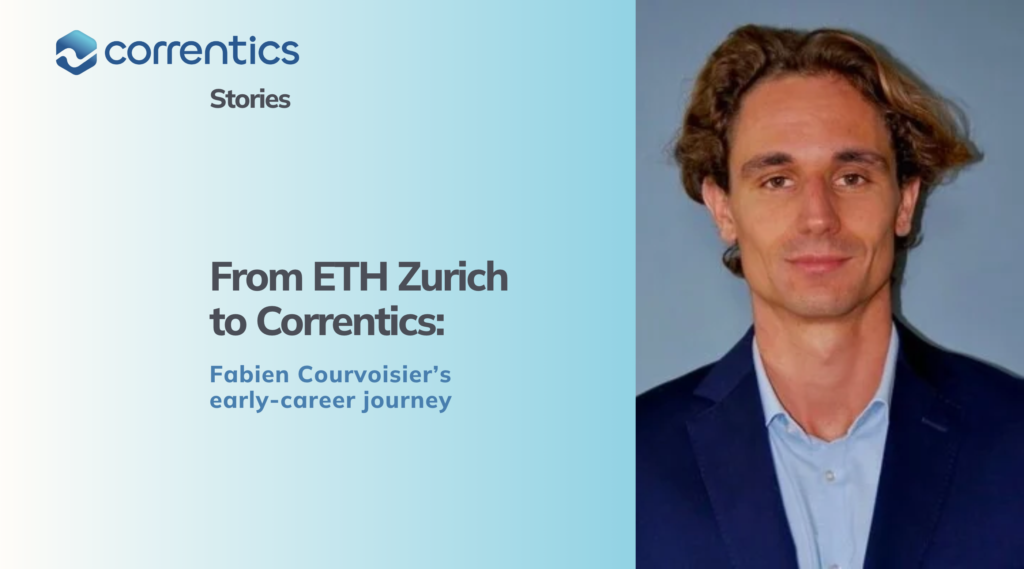
From ETH Zurich to Correntics: Fabien Courvoisier’s early-career journey
- Zurich, November 3, 2026
Fabien Courvoisier graduated from ETH Zurich in September 2025 with a master’s degree in environmental science. In early 2026, he began his career in climate risk at Correntics as a Climate Risk Analytics Intern, and his collaboration with the team continued beyond the initial internship. He now works as a Climate Data Scientist.
In this interview, he shares what drew him to Correntics, his first experiences in a start-up environment, what he enjoys most about his work, and one piece of advice for recent graduates navigating the next steps in their careers.
1. How did you make the transition from ETH Zurich to working at Correntics?
Climate risk has always been a field that I’ve found very interesting. I was introduced to risk management, particularly in mountainous environments, during my bachelor’s degree in environmental science at the University of Lausanne. Later, during my master’s at ETH Zurich, I became increasingly interested in climate risk and adaptation to climate change.
I wanted to explore this field further and reached out to the Correntics team about a potential collaboration. I particularly liked the idea of using innovation and scientific analysis to support climate adaptation. Climate change can remain abstract for companies until its potential impacts on their own activities are made more concrete. Quantifying these risks can help create awareness and support decision-making. I found that combination relevant and timely, and saw climate risk as a field with significant potential for the future.
2. Tell us a bit more about your early days at Correntics.
My first project focused on climate risks across a client’s global portfolio in the energy sector.
The Correntics Climate Risk Analytics platform gives us an initial portfolio-level screening of the main climate risks. From there, we can combine the results with discussions around the client’s activities and concerns to identify where a deeper assessment makes sense. This means moving from portfolio screening to more detailed site-level analyses of specific hazards.
During my first week at Correntics, I was already involved in discussions with clients to understand their needs and translate them into specific requirements for the analyses. Over time, I was given more independence to develop methods and carry different parts of the project forward. I really appreciated that trust from the beginning. There’s probably no better way to learn quickly.
3. What do you like most about working at Correntics?
I like how practical and applied the work is. We use scientific methods and data, but always with a concrete question behind them. The objective is not only to produce an analysis but also to ensure that the results are robust, understandable and useful for the client.
I also like the variety. Different sectors have different challenges and priorities, so you learn a lot about the industries through the projects.
Finally, I really enjoy the start-up environment. I have the opportunity to take initiative, develop my own ideas, and discuss them with the team. Working closely with the team towards shared goals is very motivating.
4. Is there anything in particular that you learned at ETH Zurich that helps you in your current role at Correntics?
The most useful thing I learned at ETH Zurich, particularly while working on my master’s thesis, was how to approach problems scientifically: how to formulate a research question, develop a methodology, analyse and interpret results, understand their limitations, and communicate findings transparently. This is very similar to what I’m currently doing at Correntics, although within the practical constraints of the private sector.
During my time at ETH Zurich, I also acquired a solid understanding of climate modelling. Understanding how climate models and projections work, as well as their limitations, is particularly valuable because they form a significant part of the scientific foundation behind Correntics’ platform. It also helps me to understand what drives the results and how to communicate them transparently.
5. If you could give one piece of advice to students starting their careers, what would it be?
The job market is certainly difficult, especially just after graduating, so I don’t think it is realistic to wait indefinitely for a perfect first job. I was fortunate to find a role that matched my interests very well, but I’d still encourage students to remain thoughtful about what they want from their work. At that stage of life, we’re still very curious, so I think it’s worth making the most of that curiosity, exploring different opportunities, and not being afraid to knock on doors when something genuinely interests you.
6. Looking ahead, what would you like to do?
I want to continue working in climate risk and developing my experience in the field. There’s still a lot to learn, and I’m still far from having explored everything the field has to offer. At Correntics, I’d be happy to keep working on different projects and continue providing analyses that clients can trust and use to inform their decisions.
Related notes