- Category: Reporting and disclosure
- Industry: climate disclosure, climate reporting, climate risk, climate risk assessment, resilience
Building Resilience into LEED v5: What the New Climate Resilience Assessment Means — and How Correntics Can Help
- Zurich, November 17, 2025
As climate change continues to amplify risks globally, climate resilience is becoming increasingly a prerequisite in the planning of any new building or infrastructure project. The recent wildfires in California or the impacts of hurricanes and flooding events are just a few examples that highlight the importance of incorporating resilience aspects into new constructions and into the improvement of existing buildings. The U.S. Green Building Council’s latest update of the leading green building standard, LEED v5, makes this shift clear. For the first time, every project pursuing LEED v5 certification must complete a Climate Resilience Assessment (Integrative Process prerequisite IPp1).
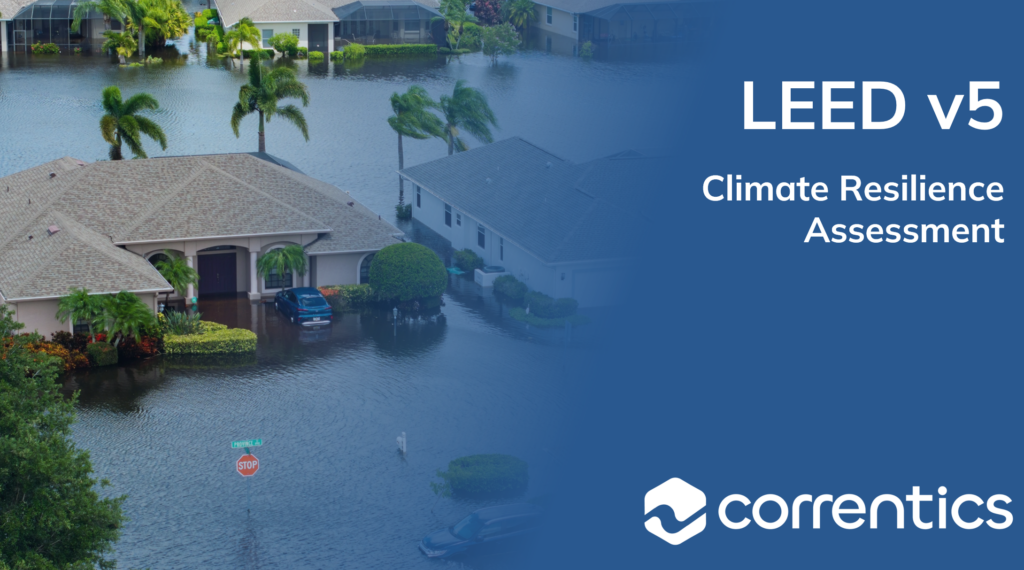
Understanding and planning for climate hazards is now fundamental to responsible building design and operation.
At Correntics, we help organisations make this shift — translating complex climate data into actionable insights for design, investment, and operations. Here’s what the new requirement entails and how our tools and expertise can support your project.
What the LEED v5 Climate Resilience Assessment Requires
Under LEED v5, the Climate Resilience Assessment has become a mandatory first step. The intent is simple but far-reaching: ensure every project team understands how current and future climate conditions could affect their site and building performance.
1. Identify relevant climate hazards
Projects must evaluate both historical and projected climate risks for their site under relevant climate scenarios for hazards such as extreme heat, flooding, and storms to drought, wildfire, or sea level rise. Teams must consider not only what has happened in the past but what may emerge over the building’s service life.
2. Analyse exposure and vulnerability
The assessment goes beyond listing hazards. The assessment needs to analyse how exposed the site is, how sensitive its assets or systems are, and how much adaptive capacity exists. This “exposure–sensitivity–adaptive capacity” framework forms the basis for understanding vulnerability.
3. Prioritise key risks
LEED v5 requires that teams prioritise at least two significant hazards and outline strategies to address them. These strategies can be physical (e.g., floodproofing, shading, backup systems) or operational (e.g., maintenance protocols, emergency plans).
4. Incorporate findings into design and operations
As a crucial element, the assessment must inform design, construction, and operational decisions and not just serve as documentation. It should guide site planning, materials choices, systems design, and resilience measures throughout the project lifecycle.
5. Document and integrate
Finally, the process must be fully documented and submitted as part of LEED v5 certification. The assessment also feeds into other resilience-related credits, such as Enhanced Resilient Site Design or Resilient Spaces, allowing teams to build on their initial work for additional certification value.
Why LEED v5 Is Raising the Bar
While in earlier versions of LEED, resilience was also discussed, the assessments were largely optional. LEED v5 recognizes that resilience is now a core performance issue, not a “nice to have.”
By making the Climate Resilience Assessment a prerequisite, USGBC is ensuring that every certified project begins with an informed understanding of its climate risks.
This change aligns with a wider shift across industries. Investors, insurers, and regulators increasingly expect asset owners to demonstrate climate preparedness. Integrating resilience early helps safeguard asset value, reduce operational disruptions, and protect occupants over the long term.
How Correntics Supports LEED v5 Climate Resilience Assessments
Meeting the LEED v5 requirement calls for credible data, adequate tools, analytical rigor, and clear documentation. That’s where Correntics can help.
1. Data-driven hazard analysis
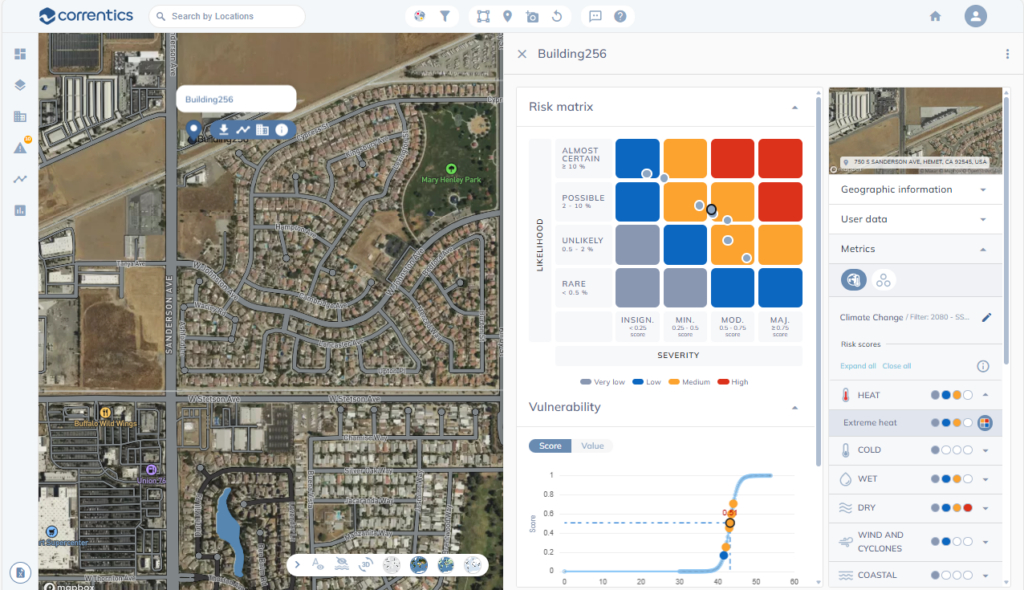
Our software integrates high-resolution global and regional datasets — covering chronic trends like temperature rise and sea-level change as well as acute hazards like floods, storms, and wildfires. We provide site-specific insights that meet LEED’s expectation for both observed and projected hazards.
2. Vulnerability and risk analytics
Correntics combines climate projections with asset data to evaluate exposure, sensitivity, and adaptive capacity. The flexible vulnerability framework can be customized to specific project needs and allows the incorporation of adaptation measures. This structured approach aligns directly with LEED’s resilience framework and helps teams focus on the most material risks.
3. Scenario and service-life modelling
We model risks under different future climate scenarios (e.g., IPCC pathways) and across the expected lifespan of your building. This ensures that design decisions are forward-looking and robust under uncertainty.
4. Actionable recommendations
Our platform doesn’t stop at analysis. Our software can be used to derive practical adaptation strategies, from site design improvements to operational measures, which helps project teams address their priority hazards in a clear, defensible way.
5. LEED-ready documentation
Correntics provides standardised outputs, summaries, and visuals that support LEED submittals. This reduces the reporting burden and gives teams confidence that their assessment meets USGBC’s expectations.
Beyond Compliance: The Business Case for Resilience
While the LEED v5 Climate Resilience Assessment supports compliance with requirements of the standard, the benefits extend far beyond certification. Projects that take climate risk seriously are more likely to:
- Protect asset value by reducing exposure to costly disruptions and damage.
- Enhance insurability and meet evolving disclosure expectations.
- Improve occupant safety and continuity of operations during extreme events.
- Unlock access to finance and sustainability-linked investment that increasingly favours resilient assets.
Integrating resilience into design and operations ultimately creates buildings that perform better across the different dimensions: environmentally, economically, and socially.
How to Get Started
For project teams beginning their LEED v5 journey, a few early actions can set the foundation for success:
- Start early — The Climate Resilience Assessment is a prerequisite, so integrate it into the pre-design phase.
- Define scope and service life — Establish which hazards, climate scenarios, and time horizons are most relevant for the assessed building.
- Engage the right expertise — Partner with resilience and data specialists who can interpret climate projections and translate them into actionable insights.
- Document continuously — Capture assumptions, data sources, and decisions throughout the process to streamline LEED documentation.
Correntics can support at each of these stages, from early scoping and data collection through risk modelling and final documentation. Our aim is to make climate resilience assessments rigorous, transparent, and decision-oriented, not just procedural.
Building for the Future
The integration of climate resilience in LEED v5 marks an important evolution in how the building industry approaches sustainability. By making climate resilience a prerequisite, USGBC is embedding risk awareness into every certified project — ensuring that design excellence also means preparedness for the decades ahead.
At Correntics, we share that goal. Our climate analytics and software solutions empower design teams, developers, and asset owners to understand their climate risks and act proactively.
If your organisation is preparing for LEED v5 or wants to strengthen its resilience strategy, we’d be glad to help.
Contact us to learn how Correntics can support your next project or portfolio with data-driven, actionable climate risk insights.